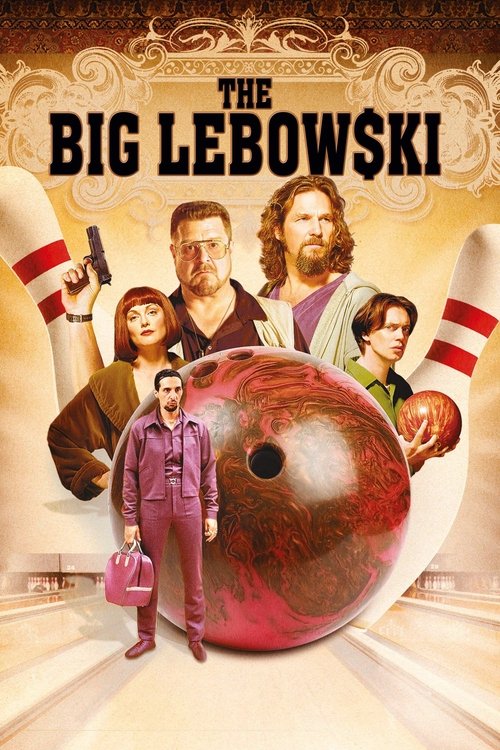
The Big Lebowski
In the hazy, laid-back world of 1998, a case of mistaken identity plunges "The Dude" into a labyrinth of eccentric characters and hilarious misadventures. "The Big Lebowski" is a cult classic that masterfully blends crime, comedy, and a truly unique philosophical outlook.
Director
Joel Coen
Release Year
1998
Runtime
117 minutes
Main Cast
Jeff Bridges, John Goodman, Julianne Moore, Steve Buscemi, David Huddleston
About The Big Lebowski
Joel and Ethan Coen's 1998 masterpiece, "The Big Lebowski," transcends mere comedy to become a profound exploration of existentialism, counter-culture, and the enduring quest for a rug that really ties the room together. Its unique blend of surreal humor, unforgettable dialogue, and a surprisingly intricate plot has cemented its place in cinematic history, resonating with audiences who appreciate its distinctive voice and unconventional narrative.
The film introduces us to Jeffrey "The Dude" Lebowski, a quintessential Los Angeles slacker whose greatest concerns are his bowling league and an endless supply of White Russians. His placid existence is violently interrupted when he is mistaken for a millionaire namesake, leading to a series of escalating absurdities involving a kidnapped trophy wife, a band of nihilists, and a severed toe. The plot, while seemingly convoluted, serves as a backdrop for the Coen Brothers' signature style, allowing for insightful character studies and satirical commentary on various societal archetypes.
Upon its initial release, "The Big Lebowski" received mixed reviews, with some critics struggling to categorize its unconventional humor and narrative structure. However, over time, its critical stock soared, and it is now widely regarded as one of the greatest comedies ever made. Its influence is evident in countless homages and references across various media, and it has spawned a devoted global fanbase, with annual "Lebowski Fests" celebrating its enduring legacy.
The cultural impact of "The Big Lebowski" is undeniable. It has birthed a unique vernacular, with phrases like "The Dude abides" and "This aggression will not stand" entering the popular lexicon. The film's exploration of disillusionment, friendship, and the search for meaning in a chaotic world continues to resonate, making it a timeless work that invites repeated viewings and endless analysis.
Drafts Featuring The Big Lebowski
Every SnakeDrafts listicle where this movie appears
The Best Jeff Bridges Movies Ranked
Ranked #1
The Best Philip Seymour Hoffman Movies
Ranked #7
The Best Steve Buscemi Movies
Ranked #3
The Best John Goodman Movies Ranked
Ranked #1
The Best John Turturro Movies Ranked
Ranked #3
The Essential Julianne Moore Movie Ranking: Her Most Iconic Performances
Ranked #2
The Definitive David Thewlis Movie Ranking
Ranked #4
The Complete Ranking of Sam Elliott Movies
Ranked #2
The Definitive Ranking of Comedy Movies
Ranked #6
Best 1998 Movies of All Time
Ranked #2
The Best Movies of the 1990s Ranked
Ranked #11
The Greatest Crime Movies of 1998
Ranked #5
The Greatest 1990s Comedy Movies Ranked
Ranked #3
The Greatest 1990s Crime Movies Ranked
Ranked #14
Similar Movies
Movies related to The Big Lebowski
Frequently Asked Questions
Everything you need to know about The Big Lebowski
- The rug in The Big Lebowski symbolizes the disruption of The Dude's simple, comfortable life. When it's soiled, it represents the violation of his sanctuary and becomes the catalyst that inadvertently pulls him into the film's complex plot.
- "The Dude abides" signifies his stoic acceptance of life's absurdities and his ability to remain calm and authentic amidst chaos. It encapsulates his laid-back approach to life and his unwillingness to be shaken by external events.
- Bunny Lebowski's disappearance is not a genuine kidnapping but a deceptive scheme she orchestrated with the nihilists. Her motivation was to extort money from her wealthy husband, believing she could get away with it.
- The bowling alley serves as a sanctuary and a central meeting point for The Dude and his friends, Walter and Donny. It represents a constant in The Dude's otherwise chaotic life, a place where he can find solace and camaraderie.
- The nihilists in The Big Lebowski represent a comedic exaggeration of philosophical nihilism, embodying a lack of belief in meaning or values. Their ridiculous actions and pronouncements serve as a humorous counterpoint to The Dude's more grounded, albeit unconventional, worldview.

