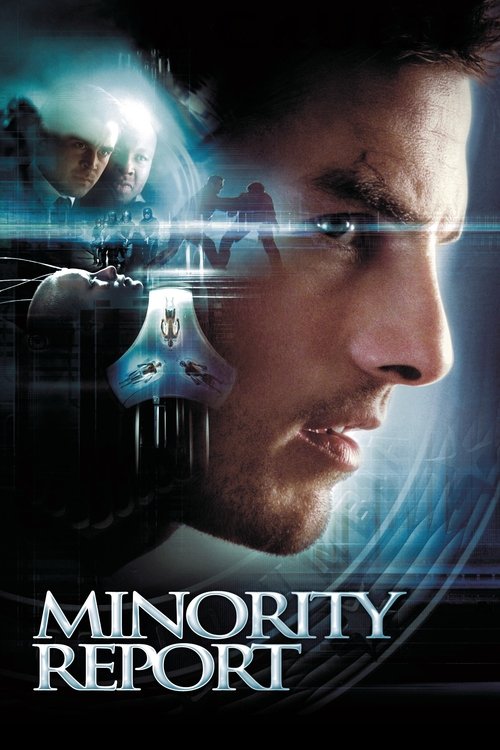
Minority Report
In a future where crimes are stopped before they start, a PreCrime unit detective finds himself accused of a murder yet to be committed. This gripping Steven Spielberg sci-fi thriller, starring Tom Cruise, explores free will versus determinism in a visually stunning and thought-provoking cinematic experience.
Director
Release Year
2002
Runtime
145 minutes
Main Cast
Tom Cruise, Samantha Morton, Colin Farrell, Max von Sydow, Kathryn Morris
About Minority Report
Steven Spielberg's *Minority Report* arrived in 2002 as a towering achievement in science fiction cinema, adapting Philip K. Dick's 1956 short story "The Minority Report" into a prescient meditation on justice, technology, and individual liberty. The film’s aesthetic, a blend of sleek futurism and gritty realism, has profoundly influenced subsequent sci-fi productions. Its depictions of personalized advertising, gesture-based interfaces, and autonomous vehicles felt fantastical in 2002 but have since become increasingly relevant, cementing its status as a landmark film in the genre.
The narrative centers on John Anderton, a dedicated PreCrime captain in Washington D.C., where three psychics, known as "PreCogs," foresee murders before they occur, allowing law enforcement to intervene and arrest perpetrators. This seemingly infallible system has eliminated murder for six years. However, the film’s central conflict arises when Anderton himself is implicated in a future murder, forcing him to question the system he has so fiercely upheld and embark on a desperate quest for the truth, all while evading his former colleagues.
Critically lauded upon its release, *Minority Report* garnered widespread acclaim for its intelligent screenplay, breathtaking visual effects, and Spielberg’s masterful direction. Critics praised its ability to combine thrilling action sequences with profound philosophical questions about fate, choice, and the potential pitfalls of predictive governance. The performances, particularly Tom Cruise's compelling portrayal of the hunted protagonist and Samantha Morton's ethereal turn as Agatha, were also singled out for praise. The film was nominated for an Academy Award for Best Sound Editing, among other accolades.
Beyond its immediate impact, *Minority Report* has endured as a touchstone for discussions on privacy in the digital age, the ethics of artificial intelligence, and the tantalizing, yet terrifying, prospect of a perfectly controlled society. Its influence can be seen in numerous films and television series that explore similar themes of surveillance and predetermination, solidifying its legacy as a modern classic that continues to provoke thought and spark debate about the kind of future we are building.
Drafts Featuring Minority Report
Every SnakeDrafts listicle where this movie appears
The Best of Tom Cruise Movies Ranked
Ranked #18
The Best Cameron Diaz Movies Ranked
Ranked #4
Every Colin Farrell Movie Ranked
Ranked #5
Ranking the Best Steven Spielberg Directed Movies
Ranked #13
Top 2000s Movies Ranked
Ranked #56
Top 2002 SciFi Movies Ranked
Ranked #1
2002's Best Movies Ranked
Ranked #16
The Greatest Action Movies of the 2000s Ranked
Ranked #17
The Greatest Action Movies of 2002
Ranked #4
The Greatest Action Movies Ranked
Ranked #38
Best Max von Sydow Movies Ranked
Ranked #20
The Greatest Thriller Movies of 2002
Ranked #5
The Best 2000s SciFi Movies Ranked
Ranked #4
Similar Movies
Movies related to Minority Report
Frequently Asked Questions
Everything you need to know about Minority Report
- The 'minority report' refers to instances where one of the PreCogs has a different vision of a future crime than the other two. This discrepancy is crucial, as it suggests that the predicted future isn't absolute and that free will might still exist, providing a crucial loophole in the PreCrime system and offering Anderton a glimmer of hope for his own innocence.
- The core of *Minority Report* lies in this philosophical debate. The PreCrime system embodies determinism, suggesting a future so certain it can be prevented. Anderton's journey, however, champions free will, as he fights against a predetermined fate, questioning whether actions are truly inevitable or if individuals can alter their destiny.
- Agatha is one of the three PreCogs and is uniquely sensitive to the visions. Her connection to Anderton is deeply personal; she was the PreCog in his son's murder vision. She serves as a guide for Anderton, offering cryptic clues and insights into the PreCrime system's flaws, and ultimately becomes central to uncovering the truth.
- The ubiquitous optical scanners in *Minority Report* serve as a chilling depiction of a surveillance society, constantly identifying individuals and delivering personalized advertisements based on their retinal scans. This technology highlights the film's exploration of privacy invasion and commercial exploitation in a technologically advanced future, making a statement about data collection and its implications.
- The ending reveals the inherent flaws and ethical quandaries of the PreCrime system, leading to its eventual dismantling. Anderton's actions expose that the system, while seemingly perfect, was capable of manipulation and denied individuals the fundamental right to choose. The resolution suggests a shift back towards a justice system that values nuance and individual agency over absolute prediction.

