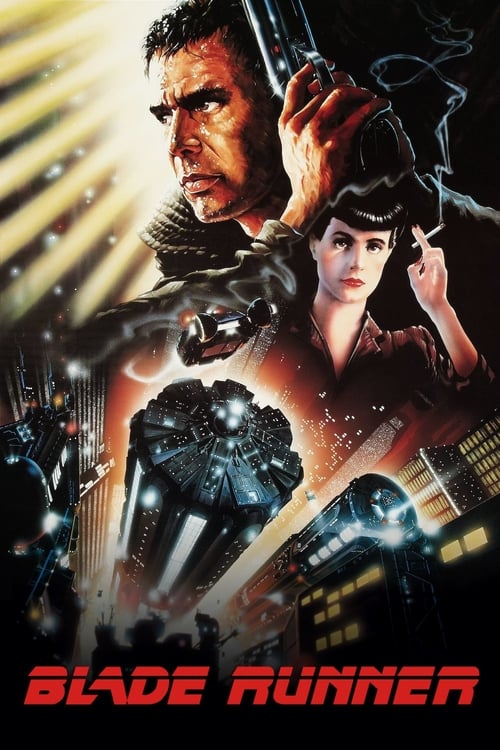
Blade Runner
Ridley Scott's 1982 neo-noir masterpiece "Blade Runner" immerses viewers in a rain-soaked, dystopian Los Angeles, where a retired detective hunts rogue synthetic humans. This visually stunning and philosophically rich science fiction thriller explores profound questions about humanity, memory, and existence, cementing its place as a cinematic landmark.
Director
Release Year
1982
Runtime
118 minutes
Main Cast
Harrison Ford, Rutger Hauer, Sean Young, Edward James Olmos, M. Emmet Walsh
About Blade Runner
Long before the term "cyberpunk" became mainstream, Blade Runner (1982) visually defined the subgenre with its breathtaking depiction of a perpetually dark, genetically engineered future. Its influence permeates countless films, video games, and anime, shaping our collective imagination of a technologically advanced yet morally ambiguous world. The film’s intricate production design, combining dazzling special effects with a gritty, lived-in aesthetic, created a truly unique and immersive experience that continues to captivate audiences.
The film centers on Rick Deckard, a "blade runner" tasked with "retiring" rogue replicants—bioengineered humanoids indistinguishable from real humans. These replicants, intelligent and powerful, yearn for a longer life than their predetermined four-year lifespan, setting in motion a complex cat-and-mouse game through the neon-drenched streets of Los Angeles. The narrative expertly weaves elements of detective fiction with profound philosophical inquiries, prompting viewers to question the very definition of life and what it means to be human.
Upon its initial release, Blade Runner received mixed reviews and struggled at the box office. However, its reputation grew significantly over time, eventually achieving cult status and widespread critical acclaim. Critics later lauded its intricate world-building, thematic depth, and groundbreaking visual effects. The film's enduring legacy is evident in its numerous retrospective analyses, academic studies, and the enduring fascination it holds for filmmakers and film enthusiasts alike.
Blade Runner garnered several awards and nominations, including two BAFTA Awards for Best Cinematography and Best Production Design, and a nomination for Best Visual Effects at the Academy Awards. Its status as a highly influential and important film has only solidified with age, leading to multiple re-releases and director's cuts that offer different interpretations of its ambiguous narrative. Its cultural impact is immeasurable, inspiring generations of artists and thinkers to explore the complexities of artificial intelligence and the future of humanity.
Drafts Featuring Blade Runner
Every SnakeDrafts listicle where this movie appears
The Best Harrison Ford Movies Ranked
Ranked #4
Ranking Ridley Scott's Greatest Films
Ranked #3
Every Daryl Hannah Movie Ranked
Ranked #1
The Definitive Ranking of Sean Young Movies
Ranked #1
Best Edward James Olmos Movies Ranked
Ranked #2
A Ranking of Rutger Hauer's Best Movies
Ranked #1
Top Movies of 1982 Ranked
Ranked #2
The Best SciFi Movies of 1982, Ranked
Ranked #1
Top 1980s SciFi Movies Ranked
Ranked #2
The Best Thriller Movies of 1982, Ranked
Ranked #2
Top 1980s Thriller Movies Ranked
Ranked #3
The Best Movies of the 1980s Ranked
Ranked #6
Similar Movies
Movies related to Blade Runner

Frequently Asked Questions
Everything you need to know about Blade Runner
- The origami unicorn, famously left by Gaff, plays a crucial role in supporting the theory that Deckard himself might be a replicant. If Gaff knows Deckard's dreams, it suggests insight into Deckard's implanted memories, blurring the lines between human and artificial existence. This symbol reinforces the film's central theme of questioning reality and identity.
- Yes, replicants in Blade Runner demonstrably develop and experience complex emotions, often more intensely than the humans around them. The Voight-Kampff test, designed to identify replicants, relies on measuring empathetic responses, highlighting that their capacity for feeling is a key, often dangerous, aspect of their advanced design. Their emotional depth drives much of their rebellion and desire for life.
- The perpetual rain in Blade Runner's Los Angeles serves multiple symbolic purposes, contributing heavily to the film's noir atmosphere. It visually emphasizes the city's decay and oppressive mood, while also metaphorically washing away the distinctions between human and replicant, leaving an ambiguous moral landscape. The rain acts as a persistent, melancholic backdrop to the existential questions explored in the narrative.
- The replicants, particularly Roy Batty, seek out Eldon Tyrell, their creator, with a desperate plea to extend their limited four-year lifespans. They harbor a deep desire for more life, believing Tyrell holds the key to overcoming their inherent obsolescence. This pursuit underscores their struggle for existence and their yearning for the fundamental human desire for longevity.
- The 'more human than human' slogan of the Tyrell Corporation epitomizes the ethical dilemma at the heart of Blade Runner. It suggests that replicants are not merely imitations but potentially superior beings, designed to be ideal, yet are relegated to servitude. This phrase provocatively challenges the perceived uniqueness and inherent value of humanity, especially when faced with creations that surpass biological limitations.

