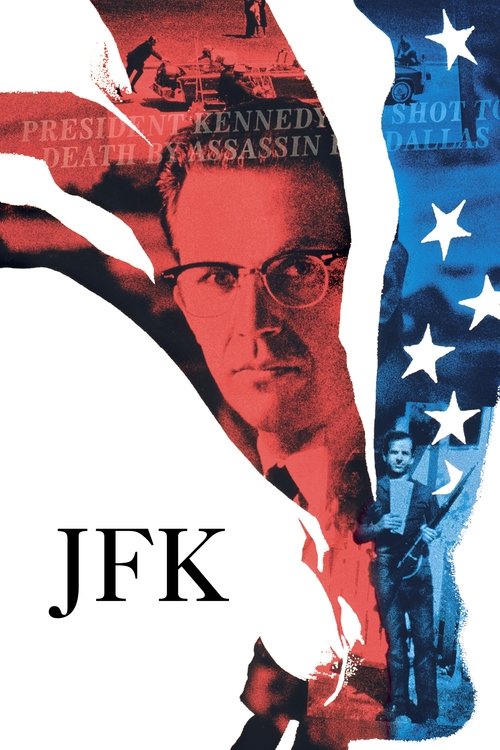
JFK
Immerse yourself in the gripping true story of Jim Garrison's relentless investigation into the assassination of President John F. Kennedy. This intense political thriller unravels the complex web of conspiracies and unanswered questions surrounding one of America's most pivotal moments, keeping you on the edge of your seat from start to finish.
Director
Release Year
1991
Runtime
189 minutes
Main Cast
Kevin Costner, Tommy Lee Jones, Gary Oldman, Kevin Bacon, Michael Rooker
About JFK
Oliver Stone's "JFK" ignited a firestorm of discussion and re-examination upon its 1991 release, delving deep into the theories surrounding the assassination of President John F. Kennedy. The film, led by Kevin Costner as New Orleans District Attorney Jim Garrison, dramatically reconstructs the events leading up to and following that fateful day in Dallas, presenting a powerful, albeit controversial, alternative narrative to the official Warren Commission report. Its impact on popular culture was undeniable, sparking renewed interest in the Kennedy assassination and influencing a generation's perspective on government transparency and historical interpretation.
At its core, "JFK" explores the relentless pursuit of truth against overwhelming odds. The plot follows Garrison as he becomes increasingly convinced that a conspiracy far grander than a lone gunman was responsible for Kennedy's death. He navigates a labyrinth of shadowy figures, conflicting testimonies, and suppressed evidence, challenging the official narrative and risking his career and personal life in the process. The film masterfully weaves together historical footage, dramatic re-enactments, and a sprawling ensemble cast to create a compelling and often unsettling vision of political intrigue.
Critically, "JFK" was a polarizing film. While some praised Stone's ambitious filmmaking, meticulous research, and powerful storytelling, others criticized its speculative nature and perceived historical inaccuracies. Despite the debate, the film garnered significant accolades, including two Academy Awards for Best Cinematography and Best Film Editing, and nominations for Best Picture and Best Director. Its commercial success proved that audiences were eager to engage with its provocative themes.
"JFK" remains a potent and enduring work, continuing to provoke thought and discussion decades after its release. Its legacy lies not only in its artistic achievements but also in its ability to challenge conventional wisdom and encourage critical examination of historical events. The film stands as a testament to the power of cinema to explore complex societal issues and spark widespread public discourse, forever cementing its place as a landmark political thriller.
Drafts Featuring JFK
Every SnakeDrafts listicle where this movie appears
The Best Kevin Bacon Movies
Ranked #9
The Best Tommy Lee Jones Movies Ranked
Ranked #3
The Best Martin Sheen Movies Ranked
Ranked #12
The Best Joe Pesci Movies Ranked
Ranked #9
The Best John Candy Movies Ranked
Ranked #7
The Best Kevin Costner Movies Ranked
Ranked #5
The Best Jack Lemmon Movies Ranked
Ranked #15
The Best Vincent D'Onofrio Movies
Ranked #5
Gary Oldman Movies Ranked: The Chameleonic Acting Legend's Essential Filmography
Ranked #7
Ranking the Best Sissy Spacek Movies: A Cinematic Icon's Greatest Hits
Ranked #10
Donald Sutherland Movies Ranked Definitively
Ranked #3
Best Movies Directed by Oliver Stone
Ranked #2
1991's Best Movies Ranked
Ranked #4
Top 1990s Thriller Movies Ranked
Ranked #16
Best Thriller Movies of 1991, Ranked
Ranked #18
Similar Movies
Movies related to JFK
The Parallax View
1974
Z
1969
All the President's Men
1976
Missing
1982
Serpico
1973
Frequently Asked Questions
Everything you need to know about JFK
- The enigmatic figure known as 'X' provides crucial, albeit clandestine, information to Jim Garrison. His insights suggest a much larger, more sophisticated conspiracy at play, pushing Garrison to question the lone gunman theory even further.
- In the film, Clay Shaw is depicted as a sophisticated businessman with alleged ties to various intelligence agencies and anti-Castro Cuban exiles. His motives are presented as being intertwined with a broader agenda to maintain certain power structures and influence, making him a key target of Garrison's investigation.
- The 'magic bullet' theory posits that a single bullet caused seven wounds in President Kennedy and Governor Connally. 'JFK' dramatically refutes this by visually demonstrating the implausibility of the trajectory, suggesting multiple shooters and a more deliberate, coordinated attack.
- The film highlights numerous eyewitness accounts that contradict the official narrative, presenting them as suppressed or ignored evidence. These witnesses, often marginalized or intimidated, provide crucial pieces of the puzzle that fuel Garrison's conviction of a conspiracy.
- The ending of 'JFK' deliberately leaves the audience with a profound sense of unease and unanswered questions. It doesn't offer definitive closure but rather reinforces the idea that the full truth of the assassination may never be revealed, encouraging viewers to continue questioning official accounts.

