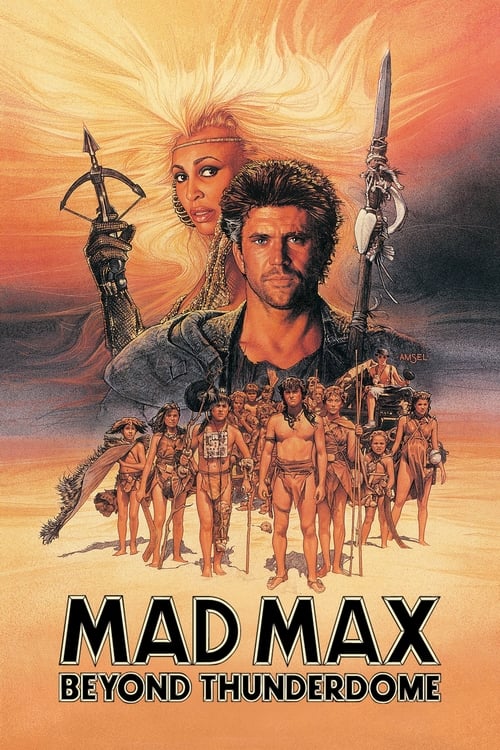
Mad Max Beyond Thunderdome
In a post-apocalyptic wasteland, Mad Max, a nomadic warrior, stumbles upon Bartertown, a seemingly civilized yet brutal settlement, only to become entangled in a power struggle that leads him to a tribe of lost children, offering a glimmer of hope in a desolate world. This iconic 80s action-adventure blends thrilling combat with profound themes of survival and community.
Director
Release Year
1985
Runtime
107 minutes
Genres
Action, Adventure, Science Fiction
Main Cast
Mel Gibson, Tina Turner, Helen Buday, Bruce Spence, Angelo Rossitto
About Mad Max Beyond Thunderdome
"Mad Max Beyond Thunderdome," released in 1985, marked a significant evolution for the Mad Max franchise, moving from the gritty, survivalist tone of its predecessors to a more fantastical, albeit still brutal, vision of the post-apocalyptic world. Its visual aesthetic, particularly the design of Bartertown and the Thunderdome itself, left an indelible mark on popular culture, influencing countless future dystopian narratives in film, television, and video games. The film's unique blend of high-octane action and a surprisingly optimistic outlook on humanity's future resonated with audiences worldwide.
The film's premise sees Max (Mel Gibson) stripped of his belongings and forced to fight in the gladiatorial arena of the Thunderdome, controlled by the enigmatic Aunty Entity (Tina Turner). His subsequent banishment leads him to a hidden oasis inhabited by a generation of children who have never known the world before the apocalypse. Max becomes their reluctant savior, guiding them towards a legendary "Tomorrow-Morrow Land." This narrative explores themes of leadership, community, and the enduring human spirit in the face of utter devastation, all while delivering the franchise's signature brand of visceral action.
Critically, "Mad Max Beyond Thunderdome" received a mixed but generally positive reception. While some critics praised its ambitious world-building and Tina Turner's commanding performance, others found it a departure from the raw intensity of "The Road Warrior." Nonetheless, the film was a commercial success, solidifying the franchise's place in cinematic history and further cementing Mel Gibson's status as a global action star. Its enduring legacy lies in its memorable characters, iconic imagery, and its unique take on the post-apocalyptic genre, proving that even in the most desolate futures, hope can still ignite.
The movie also boasts a memorable soundtrack, notably featuring Tina Turner's hit songs "We Don't Need Another Hero (Thunderdome)" and "One of the Living," which perfectly capture the film's blend of hope and desperation. These songs, coupled with Maurice Jarre's impactful score, enhance the emotional depth of Max's journey and the children's yearning for a better world. The film’s influence can still be seen in many modern dystopian productions, showcasing its lasting cultural impact.
Drafts Featuring Mad Max Beyond Thunderdome
Every SnakeDrafts listicle where this movie appears
Similar Movies
Movies related to Mad Max Beyond Thunderdome
Frequently Asked Questions
Everything you need to know about Mad Max Beyond Thunderdome
- Bartertown is the central setting in 'Mad Max Beyond Thunderdome' where much of the action takes place. It is a dystopian settlement run by the ruthless Aunty Entity, representing a decayed technological society in the post-apocalyptic world.
- Max is captured after a dramatic chase and brought to Bartertown to settle a dispute by fighting in the Thunderdome. His arrival sets off a series of events that reveal the harsh realities of this isolated community.
- The Thunderdome is a gladiatorial arena where conflicts are resolved through combat to the death or until one opponent yields. It symbolizes the brutal justice system of Bartertown and reflects the survival-of-the-fittest mentality in the film's setting.
- Aunty Entity is the authoritarian leader of Bartertown, portrayed by Tina Turner. She seeks to consolidate power by controlling resources and technology, while using Max as a pawn in her political strategies.
- After his exile, Max encounters a group of lost children living in the desert who believe in an impending salvation. He faces the challenge of protecting them from external threats and helping them find a safe place to live.
- The children are depicted as survivors who have created their own society based on hope and myths. They rely on Max as a figure of faith and leadership, highlighting themes of innocence and resilience amidst chaos.
- The film explores themes such as power struggles, survival, societal decay, and redemption. It also delves into human nature in extreme circumstances and the possibility of hope in a post-apocalyptic world.
- The harsh desert environment and the contrast between the technologically-degraded Bartertown and the children's primitive community create a stark, post-apocalyptic atmosphere. This setting reinforces the film’s themes of desolation and survival.

