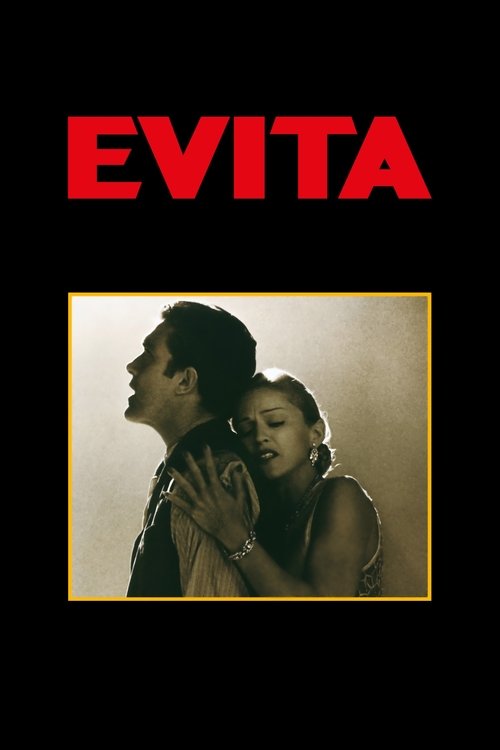
Evita
Immerse yourself in the captivating true story of Eva Perón, Argentina's iconic First Lady, as Madonna delivers a powerhouse performance in this visually stunning musical. "Evita" chronicles her meteoric rise from poverty to unparalleled political influence, all set against a backdrop of Tim Rice and Andrew Lloyd Webber's unforgettable score. Discover the woman who became both adored and reviled, forever etched in the annals of history.
Director
Release Year
1996
Runtime
135 minutes
Genres
History, Drama
Main Cast
Madonna, Antonio Banderas, Jonathan Pryce, Jimmy Nail, Victoria Sus
About Evita
Alan Parker's 1996 cinematic adaptation of Andrew Lloyd Webber and Tim Rice's musical "Evita" brought the life of Eva Perón to a global audience. The film delves into the transformative journey of a young woman from a humble background who, through sheer determination and charisma, ascended to become the deeply influential First Lady of Argentina. Her story, marked by political ambition and an unwavering connection with the working class, continues to fascinate and divide opinion even today.
Upon its release, "Evita" garnered significant critical attention, largely due to Madonna's casting in the titular role. Her commitment to portraying Perón's complex persona, both ruthless and compassionate, earned her a Golden Globe Award for Best Actress. The film also received an Academy Award for Best Original Song for "You Must Love Me," a new composition written specifically for the movie, further solidifying its musical legacy. Antonio Banderas, as the narrator Che, provided a cynical yet compelling counterpoint to Eva's idealized image, offering a critical perspective on her public and private life.
The film masterfully captures the opulent and tumultuous political landscape of 1940s Argentina, utilizing grand set pieces and elaborate costumes to transport viewers into Eva's world. While maintaining the musical's core narrative, Parker injected a cinematic grandeur that elevated the theatrical experience to a new visual spectacle. The film’s exploration of power, populism, and the cult of personality remains relevant, prompting conversations about leadership and public perception.
"Evita" stands as a significant entry in the musical film genre, showcasing the enduring power of its source material while offering a fresh interpretation. Its cultural impact extends beyond its musical achievements, serving as a cinematic biography that continues to spark debate and admiration for Eva Perón's controversial yet undeniably impactful life. The film's depiction of her unwavering dedication to the "descamisados" (shirtless ones) solidified her image as a champion of the poor, even as it highlighted the ambitious underside of her political maneuvering. Its legacy is a testament to the complex, magnetic figure at its heart.
Drafts Featuring Evita
Every SnakeDrafts listicle where this movie appears
Similar Movies
Movies related to Evita
Frequently Asked Questions
Everything you need to know about Evita
- The film emphasizes Eva Perón's strong connection with the working class, often depicting her as a champion for the poor. While it captures the immense adoration she received, it also subtly hints at the political maneuvering involved in cultivating this public image, reflecting the complex historical debate surrounding her populism.
- The character of Che serves as a critical observer and cynical narrator of Eva Perón's life. He represents the common man's perspective, questioning her motives and actions, and often vocalizing the skepticism and resentment felt by some segments of Argentine society towards her rise to power and perceived extravagance.
- The film deeply explores themes of power, ambition, and the lengths one goes to achieve and maintain influence. It showcases Eva's relentless drive to escape poverty and her masterful use of media and public image to secure a powerful position, highlighting both the intoxicating allure and the demanding sacrifices of political life.
- The iconic song 'Don't Cry for Me Argentina' is presented as Eva's emotional address to the masses, a powerful moment that encapsulates her carefully crafted public persona. It portrays her as a selfless leader devoted to her people, using pathos and charisma to solidify her bond with the Argentine populace and deflect criticism.
- While the film doesn't shy away from depicting Eva Perón's controversial aspects, such as her rapid ascent and accusations of authoritarian tendencies, it often presents them through the lens of 'Che' or as a byproduct of her ambition. It allows the audience to draw their own conclusions, acknowledging the polarized views surrounding her historical legacy without explicitly taking a definitive stance.
- The film highlights Eva Perón's political work, particularly her efforts in social welfare and advocating for women's suffrage, emphasizing her impact on the lives of ordinary Argentinians. It portrays her as a formidable political force who skillfully navigated and, at times, manipulated the political landscape to achieve her goals.

