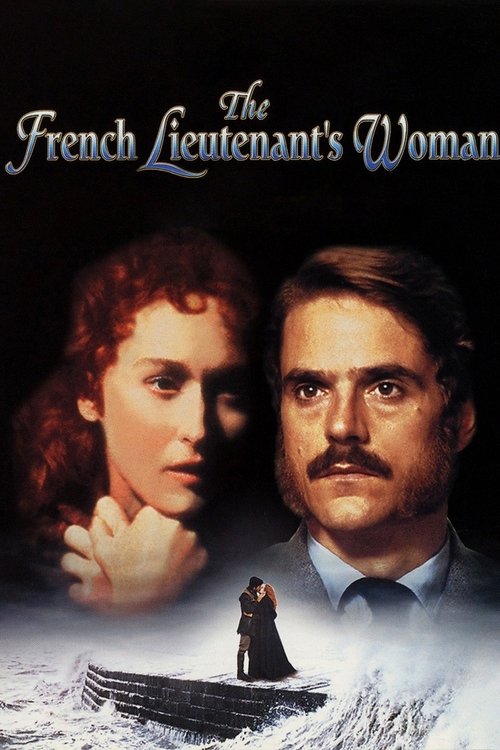
The French Lieutenant's Woman
Immerse yourself in a captivating dual narrative as “The French Lieutenant's Woman” masterfully weaves a Victorian forbidden romance with a contemporary tale of off-screen infidelity, starring Meryl Streep and Jeremy Irons. This critically acclaimed film, adapted from John Fowles' celebrated novel, explores the complexities of love, societal expectations, and artistic immersion. Discover why this historical drama remains a poignant and intellectually stimulating cinematic experience.
Director
Karel Reisz
Release Year
1981
Runtime
124 minutes
Main Cast
Meryl Streep, Jeremy Irons, Hilton McRae, Lynsey Baxter, Emily Morgan
About The French Lieutenant's Woman
“The French Lieutenant's Woman” unfolds as a richly textured narrative, blurring the lines between fiction and reality. At its core lies the tragic Victorian romance between the enigmatic Sarah Woodruff (Meryl Streep), a woman ostracized for a past scandal, and Charles Smithson (Jeremy Irons), a paleontologist engaged to another. Their forbidden affair is paralleled by a contemporary story of the actors, Anna and Mike, portraying Sarah and Charles, who find their on-screen passion spilling over into their real lives, challenging their own relationships.
The film's cultural impact stems from its audacious narrative structure, which directly addresses the metafictional elements of John Fowles' original novel. This innovative approach garnered significant critical attention and praise for its intellectual depth and emotional resonance. The Victorian segments brilliantly capture the stifling societal conventions of the era, while the modern frames offer a compelling commentary on the nature of acting, desire, and infidelity.
Critically, the film was lauded for its intelligent adaptation of Fowles' challenging source material. Meryl Streep's dual performance, embodying both the mysterious Sarah and the captivating Anna, was particularly celebrated, solidifying her status as a powerhouse performer. Jeremy Irons also delivered a nuanced portrayal of a man torn between duty and desire. The film received numerous accolades, including Academy Award nominations for Best Actress and Best Adapted Screenplay, among others.
“The French Lieutenant's Woman” continues to resonate with audiences today due to its timeless exploration of love, societal constraints, and the elusive nature of truth. Its innovative storytelling and powerful performances have cemented its place as a significant achievement in cinematic history, inspiring discussions about narrative form and the enduring power of forbidden love stories. The film's intricate layers offer a rich experience that rewards repeat viewings, inviting viewers to ponder the choices made by both the characters and the actors portraying them.
Drafts Featuring The French Lieutenant's Woman
Every SnakeDrafts listicle where this movie appears
Similar Movies
Movies related to The French Lieutenant's Woman
Frequently Asked Questions
Everything you need to know about The French Lieutenant's Woman
- Sarah Woodruff's haunted past and the scandal surrounding her character create an aura of intrigue and rebellion against Victorian societal norms. Her reputation as 'the French lieutenant's woman' makes her an outcast, yet it's this very transgression that draws Charles Smithson to her, symbolizing a yearning for liberation from convention.
- The contemporary storyline of actors Anna and Mike mirrors the Victorian romance by exploring themes of forbidden passion, infidelity, and the blurring of personal and professional boundaries. Their off-screen affair, ignited by the intensity of their roles, serves as a modern echo of Sarah and Charles's struggle against societal and personal constraints.
- The film masterfully plays with the concept of storytelling by presenting two distinct endings for the Victorian narrative, echoing John Fowles' novel. This metafictional device challenges the audience to consider the subjective nature of truth, the power of narrative to shape perception, and the elusive line between creation and reality.
- The film's ambiguous and dual endings, where the Victorian story concludes in contrasting ways, is a deliberate choice that leaves a profound impact. It encourages viewers to actively engage with the narrative, question conventional resolutions, and reflect on the complexities of human relationships and choices without a definitive, simplistic conclusion.
- The dramatic and often desolate coastal setting of Lyme Regis, particularly the Cobb, serves as a powerful symbol throughout the film. It represents a liminal space – a boundary between land and sea, convention and freedom, and the known and unknown – perfectly reflecting Sarah's outcast status and the tumultuous nature of her relationship with Charles.

