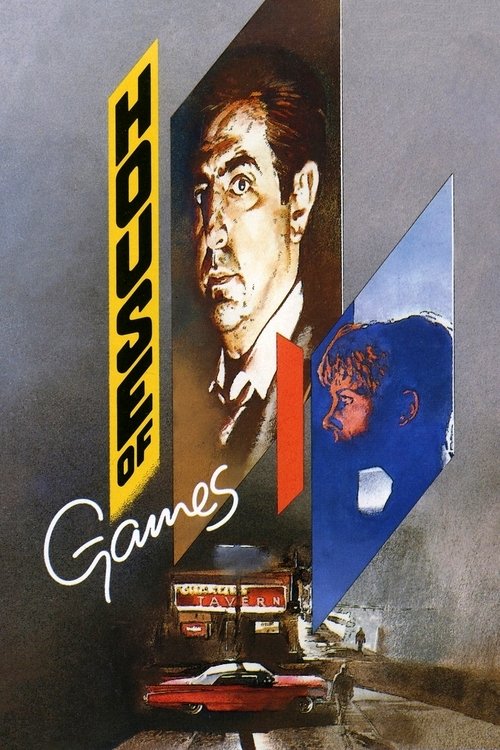
House of Games
House of Games is a masterclass in psychological manipulation, where a curious psychiatrist finds herself ensnared in a dangerous web of deception, challenging her perceptions of truth and control. This gripping thriller, from the mind of David Mamet, delves into the art of the con, keeping audiences on the edge of their seats from its elaborate opening to its shocking conclusion.
About House of Games
David Mamet's directorial debut, "House of Games," immediately established his signature style of sharp, stylized dialogue and intricate plotting. Released in 1987, the film arrived at a time when neo-noir thrillers were experiencing a resurgence, yet Mamet's unique theatrical sensibilities infused the genre with a new intellectual rigor. Its exploration of trust, identity, and the seductive nature of danger resonated deeply with critics, marking it as a significant entry in late 20th-century American cinema.
The film introduces us to Margaret Ford (Lindsay Crouse), a successful psychiatrist and author who is drawn into the murky world of professional con artists. Her initial desire to help a patient with a gambling problem quickly escalates into a personal quest for understanding, leading her to the charismatic and enigmatic con man Mike (Joe Mantegna). As Margaret becomes further entangled, the lines between observer and participant blur, and the sophisticated mind games played by Mike and his crew begin to expose the vulnerabilities and hidden desires within Margaret herself.
"House of Games" received critical acclaim for its taut direction, intelligent screenplay, and the compelling performances of its leads, particularly Lindsay Crouse's nuanced portrayal of Margaret's transformation. While not a massive box office hit, it garnered a dedicated following and cemented Mamet's reputation as a distinctive voice in filmmaking. Its influence can be seen in later thrillers that explore similar themes of psychological chess matches and the blurring of moral boundaries, and it remains a foundational text for understanding Mamet's cinematic oeuvre.
The legacy of "House of Games" lies in its enduring effectiveness as a suspenseful thriller and its insightful commentary on human nature. It's a film that demands active viewing, as every interaction, every piece of dialogue, holds potential layers of deception. Its exploration of intellectual and emotional cons continues to captivate audiences, proving that the most dangerous games are often played in the mind.
Drafts Featuring House of Games
Every SnakeDrafts listicle where this movie appears
Similar Movies
Movies related to House of Games



Frequently Asked Questions
Everything you need to know about House of Games
- The 'house of games' refers to the metaphorical space where the con artists operate, a world built on intricate deceptions and manipulated realities. It symbolizes the psychological arena where Margaret's perceptions are constantly challenged and where the truth is a fluid concept.
- Margaret's background as a psychiatrist initially makes her believe she has a keen understanding of human behavior, making her confident in her ability to analyze and perhaps even control the situation. However, this very confidence makes her susceptible to the con artists' manipulation, as they exploit her intellectual curiosity and desire for insight into the human psyche.
- The final scene is open to interpretation but suggests Margaret's complete immersion into the world of the con, where she herself becomes a master manipulator. Her actions demonstrate a profound transformation, raising questions about whether she has been corrupted, found an unexpected calling, or simply adapted to a new understanding of truth and power.
- Trust and betrayal are central to 'House of Games,' with every relationship and interaction built upon a foundation of potential deception. The film meticulously demonstrates how easily trust can be earned and then shattered, blurring the lines between sincerity and calculated manipulation, and ultimately questioning the very nature of interpersonal connection.
- David Mamet's highly stylized and deliberate dialogue is crucial in 'House of Games,' creating a distinct atmosphere of controlled tension and intellectual sparring. Each line is carefully crafted, often carrying multiple meanings, and the precise, almost ritualistic exchanges between characters underscore the calculated nature of their interactions and the constant mind games being played.

