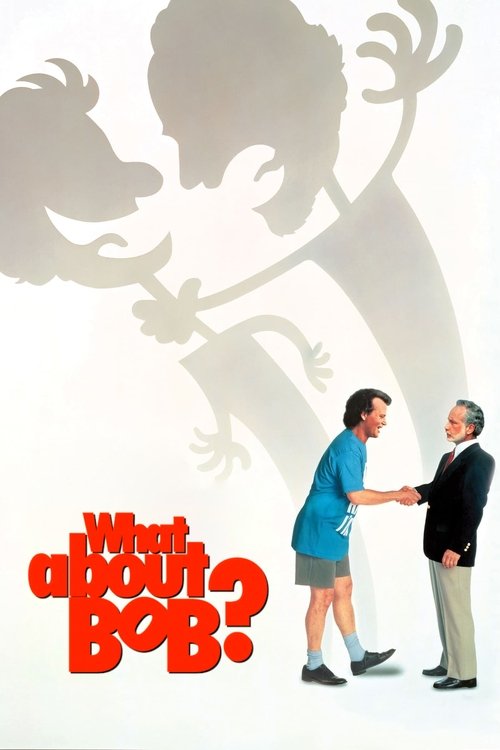
What About Bob?
Discover the hilarious chaos that ensues when a neurotic patient tracks down his vacationing psychiatrist in "What About Bob?". This quintessential 90s comedy masterfully blends slapstick with genuine character-driven humor, making it a timeless watch for anyone who's ever felt a little too close for comfort.
Director
Frank Oz
Release Year
1991
Runtime
100 minutes
Genres
Main Cast
Bill Murray, Richard Dreyfuss, Julie Hagerty, Charlie Korsmo, Kathryn Erbe
About What About Bob?
Released in 1991, "What About Bob?" quickly became a beloved staple in the comedy genre, celebrated for its unique blend of situational humor and character study. The film taps into universal anxieties about mental health, boundaries, and the unexpected disruptions life can bring, all while maintaining a lighthearted and uproarious tone.
The premise introduces us to Bob Wiley, a man defined by his myriad phobias, who becomes fixated on his new psychiatrist, Dr. Leo Marvin. When Dr. Marvin attempts to escape for a family vacation, Bob's unwitting persistence leads to a hilarious cat-and-mouse game, with Bob inadvertently charming his way into the Marvin family's lives and home. The film cleverly subverts the traditional doctor-patient dynamic, as Dr. Marvin's carefully constructed world unravels under Bob's well-meaning but relentless intrusion.
Critically, "What About Bob?" was praised for its sharp script and the dynamic performances of its lead actors. Bill Murray's portrayal of Bob Wiley is a masterclass in endearing neuroticism, while Richard Dreyfuss delivers a pitch-perfect performance as the increasingly unhinged Dr. Marvin. The film's humor often stems from the escalating absurdity of Bob's presence and Dr. Marvin's futile attempts to regain control, leading to iconic comedic moments that have endured for decades.
Beyond its comedic brilliance, the film also subtly explores themes of personal growth and the impact one individual can have on another, even if unintentionally. Bob's uninhibited approach to life, while initially infuriating to Dr. Marvin, ultimately challenges the psychiatrist's rigid worldview. Its lasting legacy lies in its ability to deliver consistent laughs while also offering a surprisingly insightful look into human behavior and the sometimes messy path to self-discovery, solidifying its place as a classic comedy.
Drafts Featuring What About Bob?
Every SnakeDrafts listicle where this movie appears
Similar Movies
Movies related to What About Bob?

Frequently Asked Questions
Everything you need to know about What About Bob?
- Bob’s 'baby steps' philosophy, initially a therapeutic technique suggested by Dr. Marvin, ironically becomes a tool of his undoing. As Bob applies this approach to his own life with relentless optimism, it inadvertently pushes Dr. Marvin further into a state of bewilderment and frustration, highlighting the stark contrast in their coping mechanisms.
- The peaceful, idyllic setting of Lake Winnipesaukee serves as a stark contrast to the internal turmoil experienced by Dr. Marvin and the chaotic energy brought by Bob. It represents Dr. Marvin's intended sanctuary, which Bob, in his oblivious pursuit of therapy, completely invades, turning a relaxing getaway into a comedic nightmare.
- Anna Marvin initially views Bob with curiosity and a degree of sympathy, quickly becoming charmed by his earnest, if unconventional, personality. Unlike her father, she finds Bob to be a refreshing presence, and his influence encourages her to confront her own anxieties and pursue her dreams, such as diving.
- The 'Death to Fanny' play, written by Dr. Marvin's daughter, becomes a poignant symbol of his unraveling. Bob's enthusiastic, if misguided, involvement and the subsequent alterations to the play further push Dr. Marvin to the brink, representing his loss of control not only professionally but also within his family and personal life.
- The film's ending, with Bob having seemingly married into the Marvin family and Dr. Marvin recovering in a mental institution, suggests a complete role reversal and a darkly comedic resolution. It implies that Bob, despite his eccentricities, has inadvertently achieved a level of integration and happiness that eludes Dr. Marvin, leaving their therapeutic relationship in a hilariously unresolved state.

